The Place Where Vietnam Began
Before Hanoi. Before Hue. Before Saigon. There was Hoa Lu. In 968 AD, after decades of regional conflict and Chinese domination, a military commander named Dinh Bo Linh unified the disparate Vietnamese territories and declared himself Emperor Dinh Tien Hoang, the first emperor of an independent Vietnam. He chose a narrow valley surrounded by limestone karst mountains as his capital — a location where the geography itself served as a defensive wall, and where a small army could hold off a much larger force.
That choice was Hoa Lu, and for 42 years it served as the political heart of Vietnam. The significance of this site extends far beyond its physical remains. Hoa Lu is where the idea of a unified, independent Vietnamese state was first made real — a fact that gives the temples, walls, and landscape a weight that transcends their modest scale. The region that surrounds Hoa Lu has, as of 2025, officially reclaimed the name, with the former Ninh Binh province reorganized under the Hoa Lu designation. The ancient capital and the modern city now share the same name, linking a thousand years of history to the present.
The Dinh Dynasty: Unification and Empire
The story of Hoa Lu begins with the chaos of the Twelve Warlords Period (966-968 AD), during which Vietnam was fragmented into competing fiefdoms following the collapse of the Ngo Dynasty. Dinh Bo Linh, a local warlord from the Hoa Lu region, systematically defeated or absorbed the other eleven warlords and established the Dai Co Viet state — the first unified Vietnamese kingdom independent of Chinese rule.
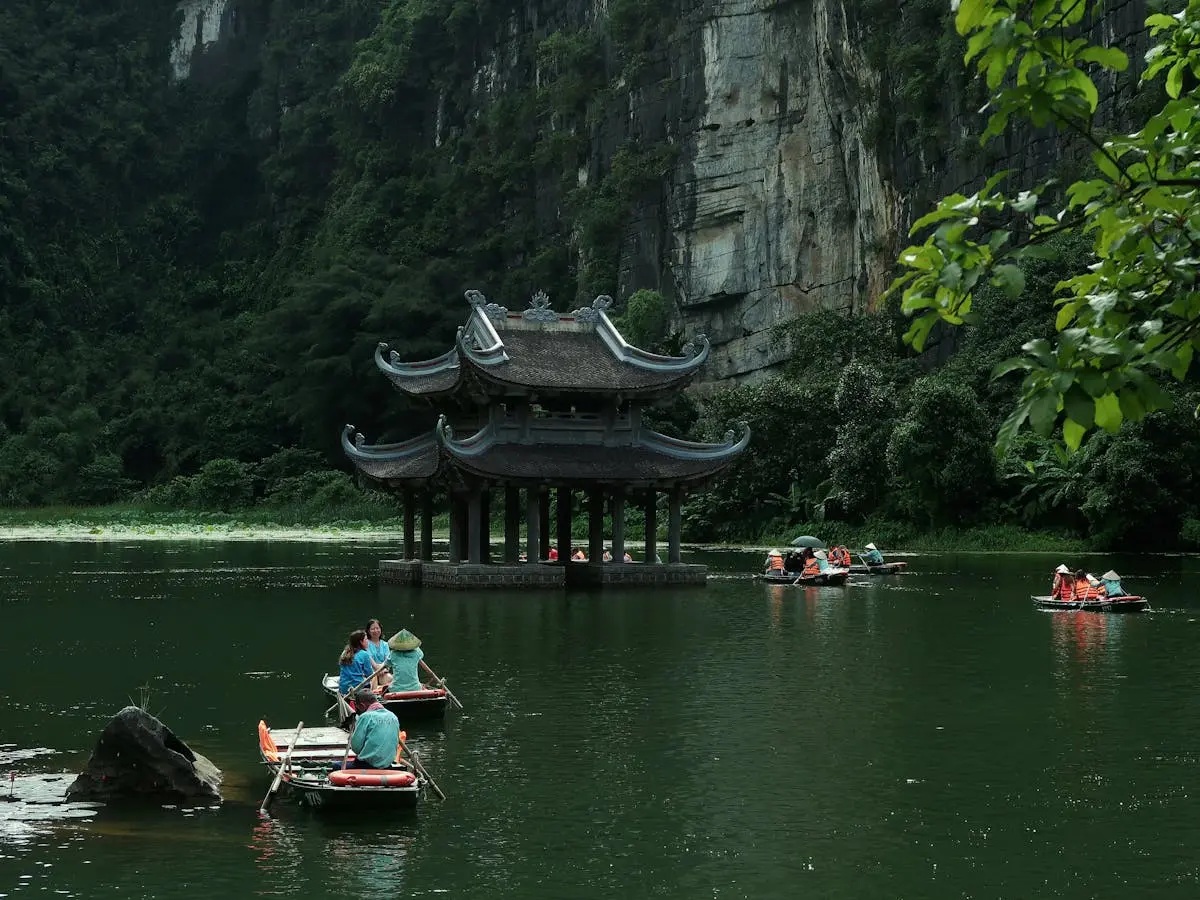
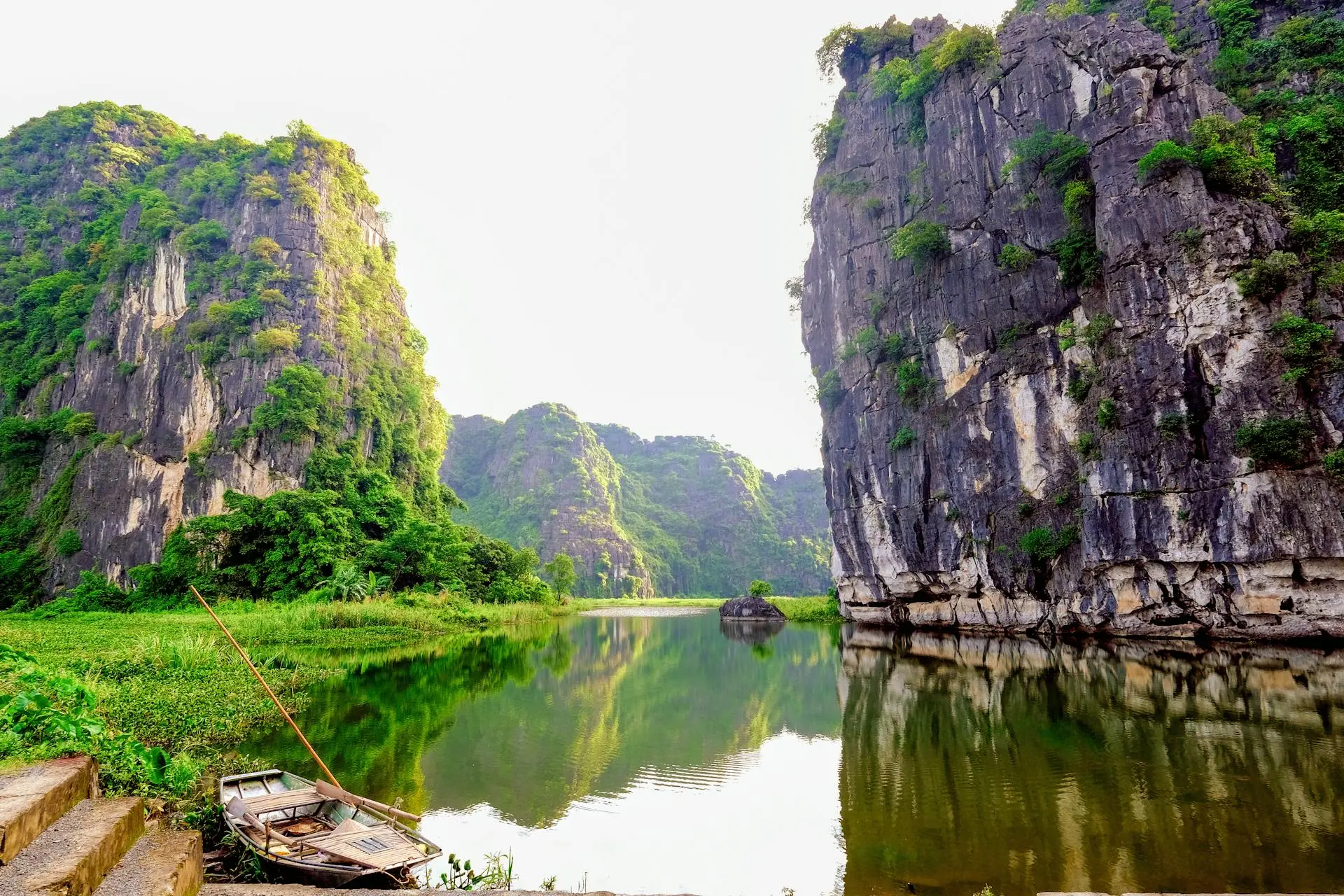
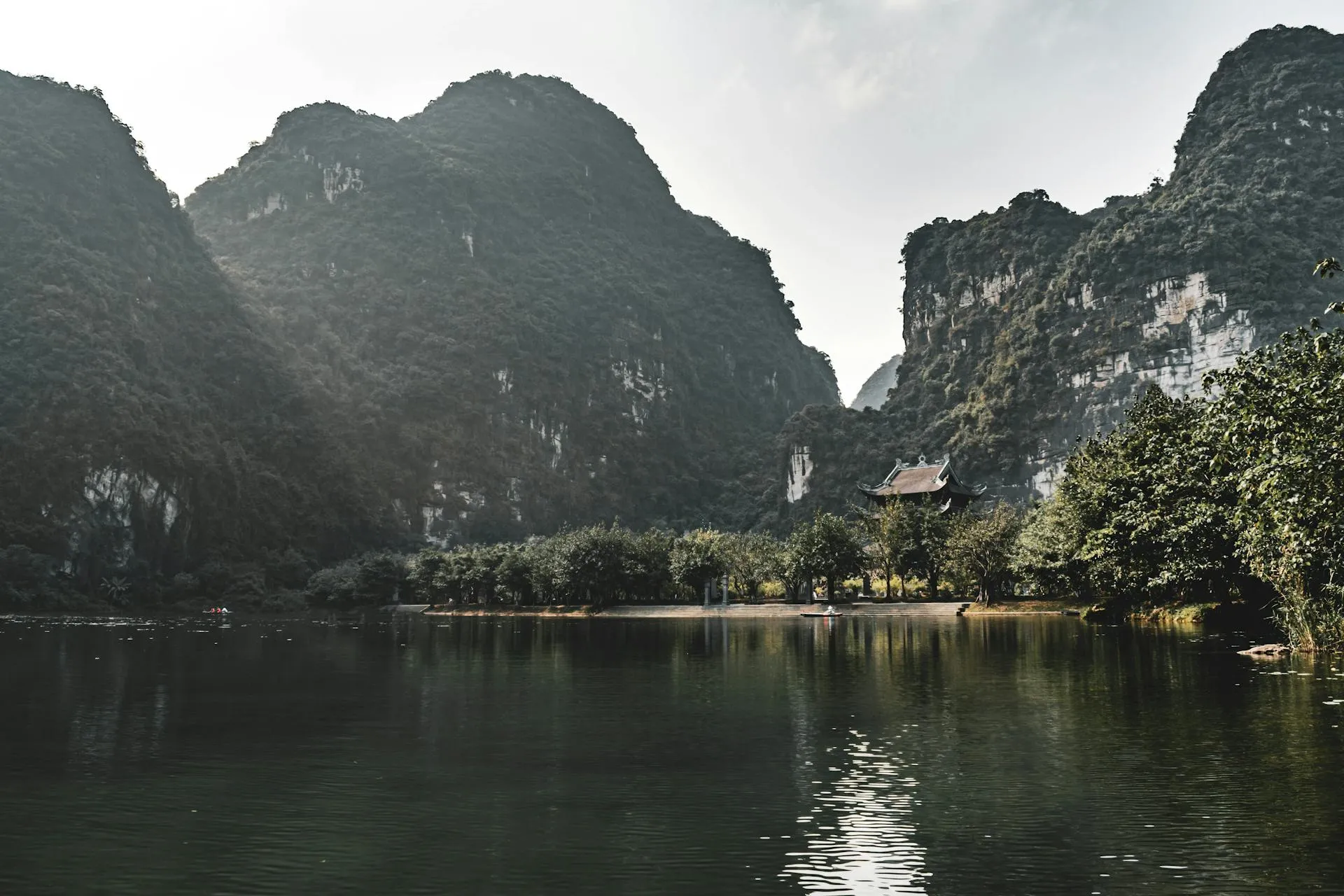
Dinh Tien Hoang chose Hoa Lu as his capital not for its beauty but for its defensibility. The valley is surrounded on three sides by limestone karst mountains, some rising over 200 metres vertically from the valley floor. The narrow approaches between the peaks could be blocked by walls and gates, creating a natural citadel. The Hoang Long River provided water access to the Red River Delta and the sea beyond, enabling trade and communication without exposing the capital to easy attack. Within this karst fortress, Dinh Tien Hoang built his palace, court, and military headquarters.
The Dinh Dynasty was short-lived but foundational. Dinh Tien Hoang was assassinated in 979 AD — reportedly by a palace servant — and his young son was unable to hold power. General Le Hoan, commander of the imperial army, assumed the throne, founding the Early Le Dynasty and maintaining Hoa Lu as the capital until 1010 AD.
The Temples: What Remains
The original palace complex at Hoa Lu no longer exists — a thousand years of weather, warfare, and neglect saw to that. What survives, and what visitors see today, are two temples built on the foundations of the original palace buildings, reconstructed primarily in the 17th century during the Le Dynasty restoration period.
The Dinh Tien Hoang Temple, dedicated to the founding emperor, is the larger and more ornate of the two. The complex includes a triple gate (Tam Quan), a courtyard with stone sculptures, and the main worship hall where a gilded statue of Dinh Tien Hoang sits on a throne. The architecture follows traditional Vietnamese temple design: heavy tiled roofs with upswept eaves, wooden pillars carved with dragon and phoenix motifs, and incense burners casting fragrant haze through the interior. The temple's approach is lined with stone guardians and ceremonial pillars, and the surrounding gardens are carefully maintained.
The Le Dai Hanh Temple, approximately 500 metres from the Dinh temple, is slightly smaller but equally significant. Dedicated to Emperor Le Dai Hanh (Le Hoan), who defended Vietnam against Song Dynasty Chinese invasion in 981 AD, the temple follows a similar architectural pattern. A notable feature is the stone pillar inscribed with historical text near the temple entrance, and the quieter, more contemplative atmosphere compared to the busier Dinh temple.
The mountains were the walls. The river was the road. And this narrow valley was where they built a nation.
The Strategic Geography
Understanding why Hoa Lu matters requires understanding its geography. The valley occupies approximately 300 hectares of flat land enclosed by karst mountains. Archaeological evidence suggests that the original citadel walls connected the natural mountain barriers, creating a continuous perimeter. Remnants of these walls — earthen ramparts reinforced with stone — can still be traced in several locations around the site, though most have been absorbed into rice paddies and village construction over the centuries.
The karst terrain made Hoa Lu virtually impregnable by 10th-century military standards. An attacking army would need to approach through narrow passes between limestone towers — passes that could be defended by small garrisons positioned on the heights above. The Hoang Long River provided a water route for supply and retreat, while the surrounding mountains concealed secondary pathways known only to locals. When Le Dai Hanh defeated the Song Dynasty invasion force in 981 AD, the terrain played a decisive role, channeling the Chinese army into kill zones where Vietnamese forces held every advantage.
This same defensive geography is visible today from the road that approaches Hoa Lu. The karst towers rise abruptly from the paddy fields, and the valley narrows as you approach the temple complex. Standing in the temple courtyard and looking up at the encircling mountains, the military logic of the site becomes immediately apparent — and the courage required to declare independence in a region bordering a vastly more powerful China becomes tangible rather than abstract.
The Move to Hanoi: Why the Capital Shifted
In 1010 AD, Emperor Ly Thai To — founder of the Ly Dynasty — made the momentous decision to relocate the capital from Hoa Lu to a site on the Red River that he named Thang Long, meaning "Rising Dragon." According to the historical text Dai Viet Su Ky Toan Thu, Ly Thai To saw a golden dragon ascending from the river as his boat approached the site, which he took as an auspicious sign. Thang Long would eventually become Hanoi.
The move was strategically sound. Hoa Lu's defensive advantages became limitations as Vietnam consolidated its independence and needed a capital suited to governance rather than fortification. Thang Long sat at the centre of the Red River Delta — the most productive agricultural region in the north — with better access to trade routes, a larger area for urban expansion, and a more central position from which to administer the growing state. Hoa Lu's narrow valley, so advantageous in wartime, was simply too confined for the administrative, commercial, and diplomatic needs of a maturing kingdom.
After the capital moved, Hoa Lu gradually returned to its natural state — a quiet valley among karst mountains, its temples maintained by monks and villagers, its imperial significance preserved in oral history and occasional royal pilgrimages. The landscape that once housed an empire became, over centuries, the landscape of farmers, fishermen, and monks. And it is in this quieter incarnation that most visitors encounter Hoa Lu today.
Practical Tips for Visiting Hoa Lu
The two temples are separated by approximately 500 metres and connected by a paved road that passes through the village of Truong Yen. Allow 30 minutes for each temple, plus walking time between them. Modest dress is appropriate — shoulders and knees should be covered when entering the temple buildings, though this is customary rather than strictly enforced. Shoes must be removed before entering the main worship halls.
The entrance fee is 20,000 VND (approximately $1 USD) — one of the most affordable major historical sites in Vietnam. The site is open daily from 7:30 AM to 5:30 PM. Early morning visits are quieter and cooler, and the temples are particularly atmospheric when incense smoke catches the morning light through the wooden lattice windows.
A knowledgeable guide transforms the Hoa Lu visit. Without context, the temples are attractive but their significance may not be immediately apparent to visitors unfamiliar with Vietnamese history. With a guide who can explain the dynastic history, the strategic geography, and the cultural importance of the site, Hoa Lu becomes one of the most intellectually rewarding stops in the region. Our guides are briefed specifically on the historical narrative, and can adapt their commentary to your level of interest — from a concise overview to a detailed exploration of 10th-century Vietnamese politics.
How to Visit Hoa Lu on a Private Tour
Two of our private day tours include Hoa Lu Ancient Capital. The Ninh Binh Essentials ($99/person) pairs Hoa Lu with Tam Coc and Hang Mua Cave — history in the morning, natural beauty in the afternoon. The Ninh Binh Odyssey ($149/person) is our premium experience, combining Hoa Lu with Bich Dong Pagoda, a private boat tour, countryside cycling, curated dining, and sunset cocktails.
Both tours include private round-trip transportation from Hanoi, an English-speaking guide with historical expertise, all entrance fees, and lunch. The private format means you spend as long as you want at each temple — there is no bus waiting in the parking lot with 40 other passengers on a fixed schedule.